Sunday, November 19, 2023
Thirty-third Sunday in Ordinary Time
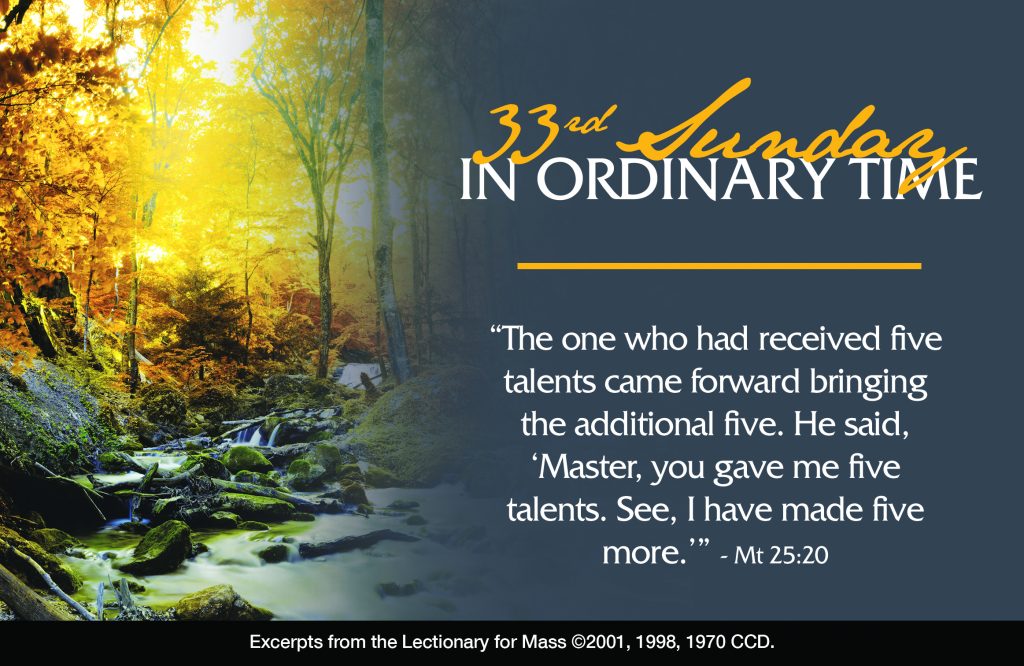
Prv 31:10-13,19-20,30-31; 1 Thes 5:1-6; Mt 25:14-30
As we are celebrating the thirty-third Sunday in ordinary time, we are called to remember that our blessings are a reward for our faithfulness.
The first reading praises the gift of a worthy wife. With her wisdom and virtues, she becomes a blessing to the husband and the household. With her ability and prudence, she multiplies the resources. With her kindness and compassion, she wins God’s favor. However, the wife becomes an endless fountain of life and fullness thanks to her faith in God. The worthy wife’s flourishing and the transformation that she makes possible are God’s gifts to her faithfulness.
The second reading highlights Paul’s words of encouragement to the Thessalonian community to keep up with their preparation for the second coming of Jesus as children of the light. Paul’s concern is that the Lord’s coming, which they all felt was imminent, should not surprise them. The apostle is highly persuasive that the community must continue the good work of being faithful disciples of the Lord. Their faithfulness in preparation for the second coming of the Lord will procure its reward of justification.
The parable of talents in the Gospel is an interesting narrative that helps us understand that God’s blessing does not often come in the form of ripe fruits but as seeds, which we are expected to plant and grow before we can taste their yield. In other words, our flourishing in life depends on the measure of our faithfulness to the Lord.
There is a fascinating detail about the master. In the version of the last servant who receives one talent, the master is a demanding person, harvesting where he does not plant and gathering where he does not scatter. However, the master, a person known for such rigidity, still chooses to trust his servants – trusts them enough to give each of them talents according to their abilities. In that sense, we find the master a very reasonable man, as opposed to the version of the last servant, who himself is not trustworthy. When the master trusts him with his money, the last servant neither trusts his master (portrays the master in a negative light) nor himself (does not put the talent to good use).
The master, as a demanding person, demands a 100% return. There is a difference in the number of talents he gives each of his servants. But the expected output is the same. All three of them are expected to double what has been given to them. There is no concession encouraged.
The first two servants prove that the master’s trust has not been misplaced. Whereas the last servant shows no semblance of faithfulness in his life. The master is shocked to find the lack of even the minimum effort. That is why he reminds him of another option that he could have considered.
In sum, the parable of talents, while explaining the nature of the Kingdom of God, invites us to examine our faithful commitment. How faithful are we to the Lord? It is the same measure that we reap as blessings in our lives.
The parable is also a reminder that when God wants to help us, He looks for what we have so that He can instrumentalize it to ensure His blessings for us. If we have something, more will be added.
The Kingdom of God is an invitation to be faithful to the Lord. The flourishing or blessing occurs as a result of our faithfulness.
Fr. Dhinakaran Savariyar
Discover more from gospeldelights
Subscribe to get the latest posts sent to your email.